Best Free Plagiarism Checker Tools for Pakistani Students (HEC Standards)
Plagiarism is one of the most serious academic offences in Pakistani universities, and the consequences can be devastating for students. The Higher Education Commission (HEC) of Pakistan has established strict guidelines that every student must follow before submitting their thesis, dissertation, or research paper. Failure to meet these standards can result in thesis rejection, degree cancellation, or even expulsion from the university. Understanding which plagiarism checker tools are reliable, free, and aligned with HEC requirements is no longer optional for any serious student in Pakistan.
The challenge, however, is that most students do not know which tools to trust. The internet is flooded with plagiarism checkers, but many of them produce inaccurate results, have tiny word limits, or keep a permanent copy of your work in their database. This means your thesis could end up being flagged as plagiarized by someone else who copies it later. For Pakistani students working on months or even years of research, this risk is simply unacceptable.
In this comprehensive guide, we have carefully evaluated and ranked the best free plagiarism checker tools that Pakistani students can use with confidence. Each tool has been tested for accuracy, database size, privacy policies, and compatibility with HEC standards. We have also included practical guidance on HEC plagiarism policies, step-by-step instructions for using these tools effectively, and tips to reduce your similarity index below the acceptable threshold.
Understanding HEC Plagiarism Standards in 2026
The Higher Education Commission of Pakistan has specific and clearly defined plagiarism policies that apply to all public and private sector universities. According to the latest HEC guidelines updated in 2026, any submitted academic work must pass through a recognized plagiarism detection tool before final approval. The HEC has designated Turnitin as its official plagiarism detection software, and all universities are required to integrate Turnitin into their thesis evaluation process. However, the reality is that many students need to check their work multiple times before the final university submission, and this is where free alternative tools become essential.
The HEC classifies plagiarism into different severity levels. A similarity index below 19 percent is generally considered acceptable for most thesis submissions, provided that the matched content consists of properly cited quotations, common knowledge statements, and standard methodological descriptions. A similarity index between 19 and 39 percent is flagged for minor revisions, meaning the student must paraphrase the matched sections and resubmit. A similarity index between 40 and 60 percent requires major revisions and may trigger a formal hearing. Anything above 60 percent is considered severe plagiarism and can lead to immediate rejection of the thesis along with disciplinary action against the student.
It is crucial to understand that HEC does not accept results from just any plagiarism checker. The commission requires that the final similarity report must be generated through the university official Turnitin account. However, for preliminary self-checks during the writing process, students can use any reliable tool to identify and fix potential issues before the final Turnitin scan. This is exactly why knowing which free tools produce results closest to Turnitin is so valuable for Pakistani students.
8 Best Free Plagiarism Checker Tools for Pakistani Students
After extensive testing with Pakistani academic content including Urdu-English bilingual research, we have identified the following eight tools as the most reliable free options. Each tool has been evaluated on its detection accuracy, database coverage, word limits in the free tier, privacy practices, and how closely its results align with Turnitin outputs.
1. Turnitin (Through University Access)
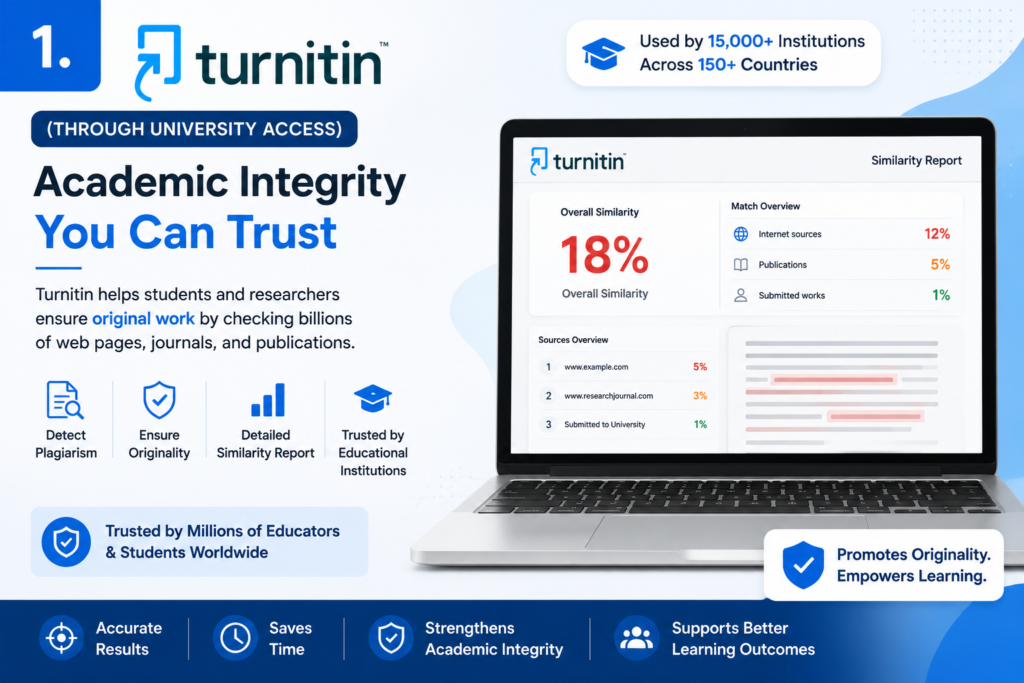
Turnitin is the gold standard for plagiarism detection and the only tool officially recognized by HEC for final thesis submissions. While Turnitin is a paid product, virtually all HEC-recognized universities in Pakistan provide free Turnitin access to their students through the university library or department. If you are a registered student, your first step should always be to check with your department about how to access Turnitin through your institution.
The reason Turnitin stands above all other tools is its database. It has access to billions of web pages, millions of published academic papers, student submissions from universities worldwide, and a vast collection of journals and periodicals. This means it can detect plagiarism from sources that other free tools simply cannot access. When you submit your thesis through your university Turnitin account, the system generates a comprehensive similarity report with color-coded highlights, a percentage score, and direct links to every matched source.
The key advantage for Pakistani students is that HEC only accepts Turnitin reports for final evaluation. This means that no matter how many times you check your work with free tools, you must ultimately run it through Turnitin before submission. Using Turnitin early and often during your writing process allows you to identify and fix issues before they become problems. Most universities allow students to submit drafts multiple times, so take full advantage of this opportunity.
Pros: Official HEC-approved tool, largest database in the world, most accurate results, comprehensive similarity reports with source links.
Cons: Only accessible through university, results are stored in database (your work becomes a source for future checks), not independently accessible.
Best for: Final thesis and dissertation checks. This is the only tool HEC accepts for official submissions.
2. DupliChecker
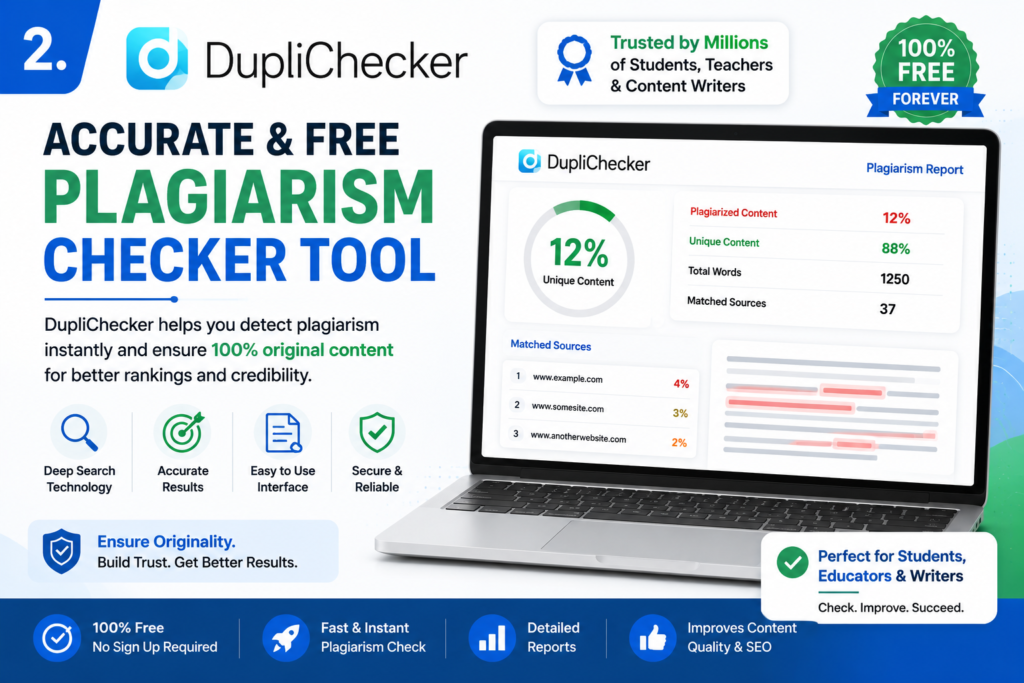
DupliChecker is one of the most popular free plagiarism checkers among Pakistani students, and for good reason. It offers a straightforward interface, does not require account registration for basic checks, and provides instant results. The free version allows you to check up to 1,000 words per query, which is sufficient for checking individual chapters or sections of your thesis one at a time.
The tool compares your text against billions of web pages and indexed content. It highlights matched sentences in red and provides percentage-based similarity scores along with links to the original sources. While its database is not as comprehensive as Turnitin and it cannot access published academic papers behind paywalls, DupliChecker is excellent for catching unintentional plagiarism from websites, blogs, and open-access online resources. For Pakistani students who extensively reference online sources in their literature reviews, this makes it an invaluable preliminary checking tool.
One important consideration is that DupliChecker may store your submitted text in its database. For thesis writers, this means you should use it for checking smaller sections and individual paragraphs rather than pasting your entire thesis at once. This precaution ensures that your own original work does not end up triggering false positives when you eventually run the complete document through Turnitin.
Pros: No registration required, instant results, 1,000 words per query, source links provided, easy to use interface.
Cons: 1,000-word limit per query, smaller database than Turnitin, may store content in database, no offline access.
Best for: Quick preliminary checks of individual sections and paragraphs before the final Turnitin submission.
3. SmallSEOTools Plagiarism Checker
SmallSEOTools is a comprehensive suite of free SEO and writing utilities, and its plagiarism checker is one of the most widely used free options globally. Pakistani students particularly favor this tool because it offers a generous free tier, a clean interface, and reliable results for web-based content. The plagiarism checker allows you to check up to 1,000 words per submission without any registration, and registered users get access to higher limits.
The tool works by breaking your text into sentence-level segments and comparing each segment against its web index. It then generates a detailed report showing the exact percentage of plagiarized content, with each matched sentence highlighted and linked to its original source on the web. The interface displays results in real time as the scan progresses, which gives you immediate feedback even for longer documents. You can also exclude specific URLs from the comparison if you know certain matches are from your own previously published work.
SmallSEOTools has improved significantly over the years, and its 2026 version includes better handling of paraphrased content detection. While it still cannot match Turnitin for academic paper detection, it is an excellent tool for identifying instances where your writing closely mirrors existing web content. For Pakistani students who write literature reviews that draw heavily from online journals and open-access repositories, SmallSEOTools provides a reliable first line of defense against unintentional plagiarism.
Pros: Free with no registration, 1,000 words per query, real-time scanning, URL exclusion feature, part of a larger SEO toolkit.
Cons: Limited to web content comparison, cannot access paywalled academic databases, 1,000-word limit may require multiple checks.
Best for: Students who need a quick, no-registration plagiarism check for web-sourced content in their assignments and thesis chapters.
4. Quetext
Quetext distinguishes itself from other free plagiarism checkers through its proprietary DeepSearch technology, which goes beyond simple keyword matching to analyze the contextual meaning of your text. This means it can detect plagiarism even when someone has tried to hide it by replacing words with synonyms or restructuring sentences. For Pakistani students working in competitive academic environments where sophisticated plagiarism attempts are a concern, this deeper analysis capability is a significant advantage.
The free version of Quetext allows you to scan up to 500 words per check, which is the smallest limit among the tools on this list. However, the quality of each scan is notably higher than most competitors. The tool produces a color-coded similarity report that distinguishes between exact matches, near matches, and paraphrased content. It also provides a comprehensive citation assistant that helps you properly format any flagged content using APA, MLA, or Chicago style.
One feature that Pakistani students will particularly appreciate is Quetext’s clean and distraction-free interface. The tool is designed specifically for academic use, unlike some competitors that are built primarily for SEO professionals. This academic focus means the results are presented in a way that makes sense for students and researchers. The tool also respects user privacy more than most free alternatives, making it a safer choice for checking unpublished thesis content.
Pros: DeepSearch technology for contextual analysis, detects paraphrased content, citation assistant included, academic-focused design, better privacy.
Cons: Only 500 words per free scan, requires account for repeated use, smaller database compared to Turnitin.
Best for: Students who want high-quality contextual plagiarism detection and are willing to check their content in shorter sections.
5. PlagiarismDetector.net
PlagiarismDetector.net is a lesser-known but surprisingly powerful free plagiarism checker that offers several features specifically useful for Pakistani students. The most notable advantage is that it supports multiple languages, including Urdu, which makes it the only tool on this list that can check Urdu content for originality. This is particularly valuable for students who write bilingual theses or need to check Urdu sections of their research papers.
The free version does not impose a strict word limit, which sets it apart from most competitors. You can paste substantial sections of your thesis for checking without needing to break it into small chunks. The tool compares your text against web pages, academic databases, and its own growing content repository. Results include highlighted matching text, similarity percentages, and source URLs. The interface is straightforward and loads quickly even on slower internet connections, which is a practical consideration for students in areas of Pakistan with limited bandwidth.
The multi-language capability extends beyond Urdu to include Arabic, Persian, and several other languages commonly used in Pakistani academic research. This makes it an excellent choice for students whose theses reference sources in multiple languages. The tool also offers a rewrite suggestion feature that helps you rephrase flagged content while maintaining the original meaning, which can save significant time during the revision process.
Pros: Supports Urdu and multiple languages, no strict word limit on free version, rewrite suggestions, works well on slow internet.
Cons: Smaller database than major competitors, interface is less polished, accuracy for English content is slightly below Turnitin-level.
Best for: Students who need to check Urdu content or work with multi-language research sources.
6. Grammarly Plagiarism Checker
Grammarly is primarily known as a grammar checker, but its free version also includes a plagiarism detection feature that compares your text against billions of web pages. For Pakistani students who already use Grammarly for grammar correction, the built-in plagiarism checker provides a convenient two-in-one solution. The plagiarism scan runs automatically when you use the Grammarly editor, and any matched content is highlighted with direct links to the original sources.
The plagiarism detection in Grammarly’s free tier checks your text against a massive database of web content. While it does not have access to the same academic paper databases as Turnitin, it excels at detecting content copied from websites, online articles, and publicly accessible documents. This makes it particularly effective for checking the introduction and literature review sections of your thesis, where students most commonly draw from online sources and may inadvertently reproduce content too closely to the original.
The seamless integration with Grammarly’s grammar checking means you can fix both grammatical errors and plagiarism issues in a single editing session. This workflow efficiency is a significant time-saver for Pakistani students who are often working under tight deadlines. The tool also works as a browser extension, allowing you to check content directly in Google Docs, WordPress, and email platforms. However, for comprehensive thesis-level plagiarism detection, it should be used alongside a dedicated academic plagiarism checker rather than as a standalone solution.
Pros: Combined grammar + plagiarism checking, browser extension for real-time use, checks billions of web pages, convenient two-in-one workflow.
Cons: Cannot access academic paper databases, web-only comparison, less detailed reports than dedicated plagiarism tools.
Best for: Students who want grammar and plagiarism checking in a single tool, especially for assignment-level content.
7. PaperRater
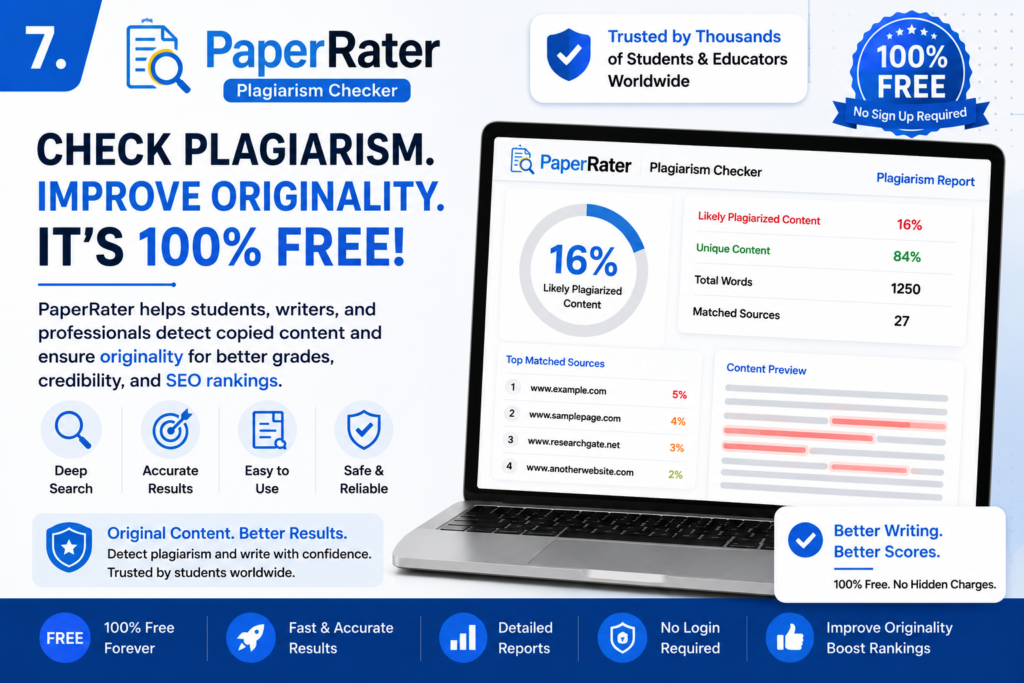
PaperRater offers a unique combination of plagiarism detection, grammar checking, and writing analysis in a single free tool. What makes PaperRater particularly appealing for Pakistani students is its generous 5,000-word limit on the free tier, which is the highest among all the tools on this list. This means you can check entire thesis chapters or long research papers in a single submission without needing to break them into smaller sections.
The plagiarism checker compares your text against a large database that includes web content, academic papers, and published articles. It generates a detailed originality score along with highlighted matching passages and source links. Beyond plagiarism detection, PaperRater also provides a comprehensive writing analysis that includes readability scoring, vocabulary enhancement suggestions, and automated proofreading. This multi-faceted approach helps students improve the overall quality of their academic writing, not just its originality.
PaperRater uses artificial intelligence to analyze your writing style and provide personalized suggestions. The tool can detect subtle forms of plagiarism that simpler keyword-matching tools might miss, such as content that has been lightly paraphrased or restructured. For Pakistani students preparing their final thesis, using PaperRater as a comprehensive pre-submission review tool can catch both plagiarism and quality issues before the official Turnitin check through the university.
Pros: 5,000-word free limit (highest on this list), combined plagiarism + grammar + writing analysis, AI-powered detection, no registration required.
Cons: Can be slow for long documents, less accurate than Turnitin for academic papers, occasional false positives on common academic phrases.
Best for: Checking entire thesis chapters at once and getting comprehensive writing feedback alongside plagiarism detection.
8. Copyleaks (Free Tier)
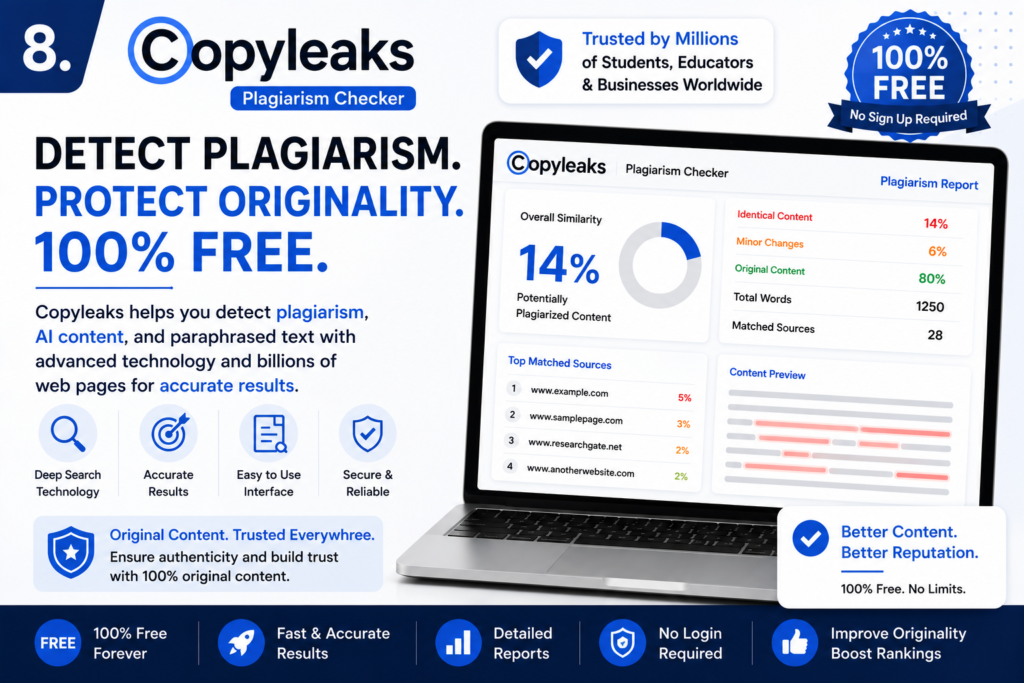
Copyleaks is a premium-grade plagiarism detection platform that offers a limited free tier, making it accessible for Pakistani students who need high-quality checks without a budget. What sets Copyleaks apart is its advanced AI-powered detection engine that can identify not only exact text matches but also paraphrased content, translated plagiarism, and even AI-generated text. In 2026, the ability to detect AI-generated content is increasingly important as more students and researchers use tools like ChatGPT in their writing process.
The free tier of Copyleaks allows you to scan up to 5 pages per submission, which translates to approximately 2,500 words. The tool compares your text against a vast database that includes web pages, academic journals, internal databases, and open-access repositories. The similarity report is comprehensive and includes percentage scores, color-coded highlights, and detailed source matching. Copyleaks also provides a side-by-side comparison view that shows your text next to the original source, making it easy to understand exactly what needs to be changed.
For Pakistani students, Copyleaks offers an additional advantage: it supports multiple file formats including DOCX, PDF, and plain text, which means you can upload your thesis document directly without needing to copy and paste content. The tool is also available as a mobile app, allowing you to check your work on the go. The AI content detection feature is particularly valuable in 2026, as HEC is increasingly concerned about AI-generated content in student submissions, and having a tool that can identify such content gives students an opportunity to properly attribute and revise any AI-assisted sections.
Pros: AI-powered detection, detects paraphrased and AI-generated content, supports multiple file formats, mobile app available, side-by-side comparison view.
Cons: Only 5 free pages per scan, requires account registration, some advanced features locked behind premium subscription.
Best for: Students who need advanced AI-powered detection and want to check for AI-generated content in their submissions.
Figure 3: Comparison of the top free plagiarism checker tools available for Pakistani students meeting HEC standards.
Comparison Table: Free Plagiarism Checkers at a Glance
The following table provides a side-by-side comparison of all eight tools based on the criteria most relevant to Pakistani university students. Use this table to quickly identify which tool best matches your specific checking needs.
Table 1: Feature Comparison of the 8 Best Free Plagiarism Checker Tools for Pakistani Students
| Tool | HEC Compatible | Word Limit | Database Size | Best For |
| Turnitin (via Uni) | Official HEC Tool | No limit | Billions | Final thesis submission |
| DupliChecker | Partially | 1,000 words/query | Millions | Quick assignment checks |
| SmallSEOTools | Partially | 1,000 words/query | Millions | Quick free scans |
| Quetext | Yes | 500 words/scan (free) | Billions | DeepSearch analysis |
| PlagiarismDetector.net | Yes | No limit (free) | Millions | Multi-language support |
| Grammarly Plagiarism | Yes | Unlimited (free) | Billions | Grammar + plagiarism combo |
| PaperRater | Partially | 5,000 words max | Billions | Full writing analysis |
| Copyleaks | Yes | 5 pages/scan (free) | Billions | AI-powered detection |
How to Reduce Your Similarity Index Below 19 Percent
Getting your similarity index below the HEC threshold of 19 percent requires a systematic approach. Many Pakistani students make the mistake of simply replacing a few words with synonyms, but modern plagiarism detection tools can see through this superficial approach. The following strategies will help you genuinely reduce your similarity score while improving the overall quality of your academic writing.
Strategy 1: Understand the difference between acceptable and unacceptable similarity. Not all matched content is plagiarism. Direct quotes with proper citations, standard definitions, commonly used methodological descriptions, and well-known facts will naturally appear as matches in any plagiarism report. HEC evaluators understand this, and a good similarity report will clearly distinguish between cited quotations and uncited copied content. Your goal is to eliminate the latter, not the former.
Strategy 2: Master the art of paraphrasing. Effective paraphrasing means completely rewriting a passage in your own words while preserving the original meaning. This is not the same as replacing a few words with synonyms. Read the original source, close it, and write the idea from memory in your own sentence structure. Then compare your version with the original to ensure you have captured the meaning without borrowing the expression. This technique alone can dramatically reduce your similarity score.
Strategy 3: Use multiple plagiarism checkers in sequence. Start with a generous-limit tool like PaperRater for a comprehensive first check. Then use a context-aware tool like Quetext or Copyleaks to catch paraphrased matches. Finally, verify your Urdu and multi-language content with PlagiarismDetector.net. This multi-tool approach catches different types of plagiarism that a single tool might miss.
Strategy 4: Properly cite every source. The most common reason Pakistani students receive high similarity scores is inadequate citation. Every time you use someone else’s idea, data, or expression, you must cite the source according to your university required referencing style (APA, MLA, Harvard, or IEEE). Proper citations not only reduce your similarity score but also strengthen the academic credibility of your work.
Strategy 5: Write your literature review thematically, not source-by-source. Many students write their literature review by summarizing one source after another, which naturally produces high similarity scores. Instead, organize your review by themes and synthesize information from multiple sources under each theme. This approach forces you to process and recombine ideas in original ways, which significantly reduces textual similarity with individual sources.
Frequently Asked Questions
Q: What is the HEC acceptable plagiarism percentage in 2026?
A: According to HEC guidelines, a similarity index below 19 percent is generally acceptable for thesis submissions. Between 19 and 39 percent requires minor revisions, between 40 and 60 percent requires major revisions, and above 60 percent is considered severe plagiarism that can lead to thesis rejection and disciplinary action.
Q: Can I use free plagiarism checkers instead of Turnitin?
A: Free tools are excellent for preliminary self-checks during the writing process, but HEC only accepts Turnitin reports for official thesis evaluation. You should use free tools to identify and fix issues early, then submit your final draft through your university Turnitin account for the official similarity report.
Q: Do free plagiarism checkers store my thesis in their database?
A: Some free tools do store submitted content, which could cause your own work to be flagged as plagiarized in future checks. To protect yourself, avoid submitting your entire thesis to any free tool. Instead, check individual sections and paragraphs, and always use your university Turnitin account for complete document checks.
Q: Which free plagiarism checker gives results closest to Turnitin?
A: No free tool perfectly matches Turnitin because Turnitin has exclusive access to academic submission databases. However, Copyleaks and Quetext generally produce results closest to Turnitin for web-based content. For the most accurate results, use your university Turnitin account, which most Pakistani institutions provide free to registered students.
Final Verdict
For Pakistani students navigating HEC plagiarism standards, the ideal approach is to use a combination of free tools for preliminary checks and Turnitin for the final submission. Start with PaperRater or DupliChecker for comprehensive early-stage scanning to identify obvious issues. Then use Quetext or Copyleaks for deeper contextual analysis to catch paraphrased content. If your thesis includes Urdu or other non-English content, PlagiarismDetector.net is your best option for checking those sections.
Remember that no tool can replace good academic writing practices. Proper citation, genuine paraphrasing, and original analysis are the foundations of plagiarism-free academic work. The tools listed in this guide are aids to help you verify your originality, not substitutes for honest scholarship. By combining these tools with solid writing habits and a thorough understanding of HEC requirements, you can submit your thesis with confidence and focus on what truly matters: contributing original knowledge to your field of study.
Start using these tools early in your writing process, check your work regularly, and always leave enough time for revisions before your submission deadline. The difference between a rejected thesis and an accepted one often comes down to thorough plagiarism checking and proper attribution. These free tools give you the power to ensure your hard work is presented in its best possible light.
Related Readings for Digital Creators & Researchers
If you are writing research papers in both English and regional languages, or running academic blogs alongside your study, structural errors can easily hurt your credibility. To avoid common writing mistakes, don’t miss our ultimate, hand-picked list of the Best Free Grammar Checker Tools for Urdu Content Writers (2026) | Top 8 Picks to make your content completely error-free and professional!